
Kiowa Court Records After Arrest
A Kiowa County arrest does not create one single public file. It creates a chain of records held by different offices. The arresting agency may hold the incident report or arrest paperwork. If the person is jailed, the custody record is usually with Bent County Jail because Kiowa County does not operate its own jail. The court-facing record begins when the case reaches Kiowa County Combined Court, which is part of Colorado's 15th Judicial District.
The formal charge decision sits with the Office of the Fifteenth Judicial District Attorney. The official DA page lists Andrew J. Hayden as District Attorney for Baca, Cheyenne, Kiowa, and Prowers counties. That matters because jail booking charges can be early arrest labels, while prosecutor-filed counts are the court charges that move through hearings, plea talks, trial settings, dismissals, amendments, and sentencing. For current custody and booking details, use Kiowa County jail inmate records; for booking-photo questions, use Kiowa County jail mugshots.
Find Kiowa Court Records
The fastest public starting point for court records after a jail arrest is the Colorado Judicial Branch docket search. Docket search is not the same as a complete case file. It is a public way to look for scheduled court events by location, date, case number, party, or attorney. Colorado Judicial says at least one filter in addition to date is required, so a party name, case number, courthouse, district, or county filter helps narrow the result.
For a Kiowa County case, choose the 15th Judicial District, Kiowa County, or Kiowa County Combined Court when those filters fit the search. If a bond paper or court notice has a case number, use it. If not, try the person's name and a date range around the arrest or first appearance. A docket can show that a hearing exists, but it may not show every filed complaint, information, order, or disposition document. Official copies usually require the court clerk or the Colorado Judicial records request route.
The Colorado docket search page shows the statewide filters used for Kiowa County court records after an arrest.
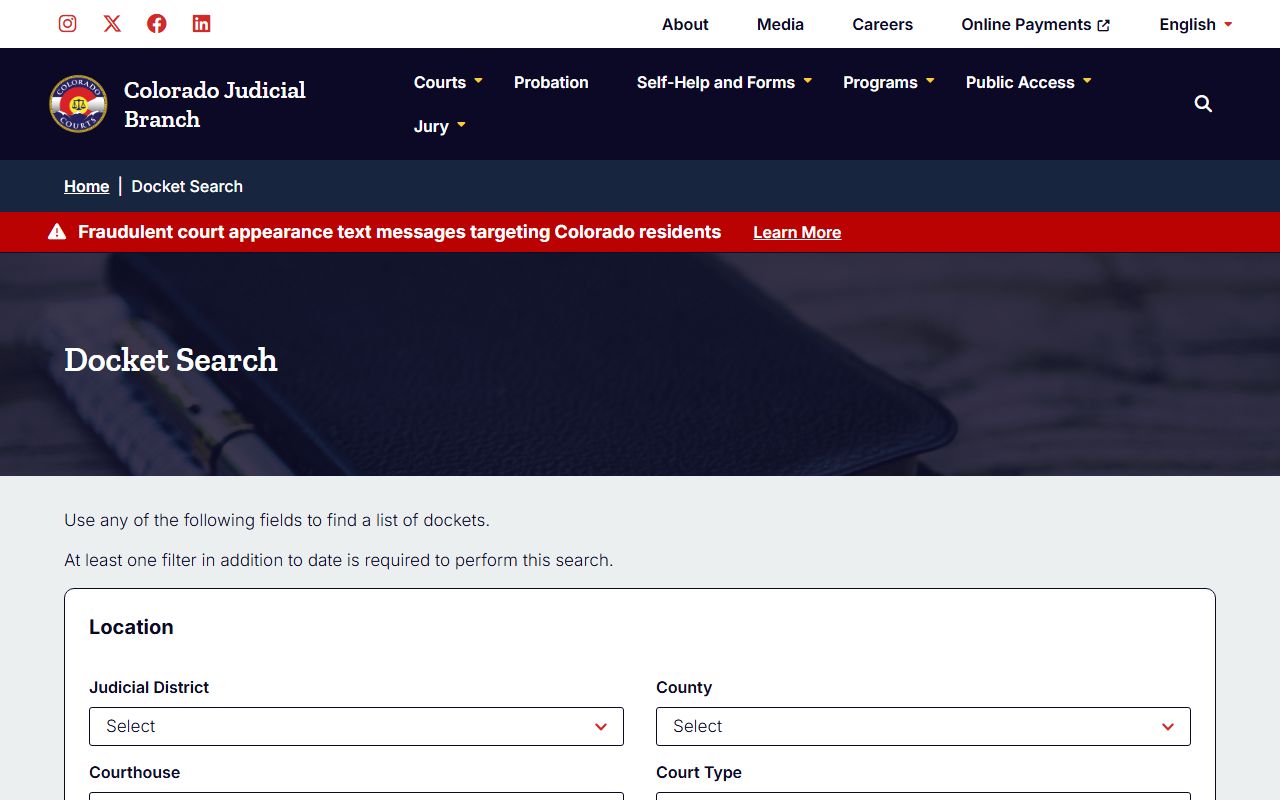
Those filters are useful when a person was booked through the regional jail route but the court case is being heard in Kiowa County.
| Field Label | Type | Required | Notes for Kiowa Searches |
|---|---|---|---|
| Judicial District | Dropdown | Optional | Kiowa County is in the 15th Judicial District. |
| County | Dropdown | Optional | Select Kiowa County when the case is local. |
| Courthouse | Dropdown | Optional | Use Kiowa County Combined Court if listed. |
| Court Type | Choice | Optional | Both, County, or District may appear. |
| Date Range | Choice/date | Conditional | Use with another filter, such as party or case number. |
| Case Number | Year, class, sequence | Optional | Useful when bond or court paperwork gives the number. |
| Party Name | Text | Optional | Search by individual first and last name when no case number is known. |
| Attorney | Name or bar number | Optional | Useful when the attorney information is known. |
Charges After Kiowa Arrest
After an arrest, the jail record may list an alleged offense or hold reason. That first booking label is not always the final court charge. The DA screens law-enforcement reports and decides what charges to file or pursue. The court file may start with a complaint, information, or indictment. In ordinary county-level criminal cases, complaints and informations are more common than grand-jury indictments.
Because Kiowa County does not run a jail, a person may be booked at Bent County Jail while the court case opens in Kiowa County Combined Court. That split is easy to miss. Jail staff can confirm custody, release, and bond-posting procedure. Court staff can route users to dockets, case-file requests, dispositions, and sealed-case rules. The DA handles prosecution decisions, but active case parties are often routed through their attorneys for case-specific DA information.
| Document | Who Usually Files It | What It Does | Kiowa County Use |
|---|---|---|---|
| Complaint | Officer or prosecutor | Begins many criminal cases and may list factual allegations and counts. | Often the first court-facing charge document after arrest. |
| Information | Prosecutor | States charges selected by the DA after screening or felony process. | Can replace, refine, or formalize earlier booking allegations. |
| Indictment | Grand jury | Charges returned through a grand-jury process. | Less common for routine local cases, but still a recognized charging document. |
Kiowa Charge Status Records
Charge status is the part of the court record that tells whether a count is still active, changed, dismissed, or resolved. A person can be arrested and booked on one suspected offense while the court record later shows a different count. Prosecutors may amend charges after reviewing reports, evidence, witness statements, criminal-history information, or plea terms. Courts may also dismiss counts, accept pleas, defer judgment, or enter a conviction after trial.
| Status | Plain Meaning | What to Check |
|---|---|---|
| Pending | The charge is still active and no final disposition appears. | Upcoming docket events, bond terms, and counsel entries. |
| Amended or Reduced | The filed charge changed from an earlier count or level. | The newest charging document and any plea entries. |
| Dismissed | The court record no longer pursues that count. | Whether other counts remain pending or resolved. |
| Conviction Disposition | The case shows a guilty plea, verdict, or other conviction result. | Sentence, probation, fines, jail credit, and appeal deadlines. |
| Sealed or Restricted | Public access is limited by law, rule, or court order. | Sealed-case route, clerk guidance, and requester eligibility. |
Note: A docket entry is not the official record of the court and may not include every filing or later correction.
Bond After Jail Arrest
Bond connects the jail record to the court record. Bent County Jail publishes bond instructions for people held there, including cash bond, cashier's check, money order, surety bond, and online credit-card bond through Access Corrections. A credit-card bond requires the inmate's name, date of birth, case number, and the full bond amount. Bond payments are made to the holding county, not to the incarcerated person.
Colorado bond law under C.R.S. 16-4-102 is important because Bent Jail republishes a rights notice based on it. The notice says bond fees, booking fees, or other debts do not have to be paid to secure release on a money bond. It also describes the $10 bond fee, the maximum 3.5 percent credit-card payment fee, and release-timing rights after bond is set, subject to exceptions such as electronic monitoring or extraordinary circumstances.
| Bond Type | How It Works | Release Caveat |
|---|---|---|
| Cash bond | Cash or cashier's check is posted for the court-set amount. | Other warrants or holds can still delay release. |
| Cashier's check or money order | Made payable to Bent County Sheriff's Office when Bent is holding the person. | Confirm current instructions before travel. |
| Credit-card bond | Online payment through Access Corrections when the required case data is known. | Card fees are limited by the published bond notice. |
| Surety bond | A bondsperson posts through a surety arrangement and charges a non-refundable fee. | The surety process does not erase court dates or case duties. |
| PR bond | Release on promise to appear and comply with conditions. | Jail processing time still applies after the order returns to the jail. |
Warrants and Court Records
No official Kiowa County public active-warrant list was located in the research. Warrant checks therefore use a practical chain. Call the Kiowa County Sheriff's Office at 719-438-5411 for local law-enforcement routing. After hours, Kiowa's own contact page routes callers to Bent County Dispatch at 719-456-1363. For a bench warrant tied to a missed hearing or court order, the Kiowa County Combined Court clerk may be the better source.
Docket search can show events related to a criminal case, but it is not a comprehensive warrant database. If a warrant has been served and the person is booked, custody may be confirmed through Bent County Jail by phone or through the inmate feed when it works. Active investigations, victim-related material, juvenile matters, and active court cases may limit what a non-involved person can receive through a records request.
- Arrest warrant
- A court order authorizing arrest based on probable cause or a charging document.
- Bench warrant
- A court-issued warrant, often for failure to appear or violation of a court order.
- Detainer
- A hold or notice from another agency that can block release even when local bond is posted.
- First appearance
- An early court hearing where rights, charges, and release conditions may be addressed.
Charge Versus Conviction
A charge is an accusation. A conviction is a court outcome. That difference matters for Kiowa County court records after an arrest because a roster, docket, or early complaint can list allegations before the case is decided. A conviction appears only when the court record shows a guilty plea, guilty verdict, or other conviction disposition. Dismissed and reduced counts should not be described as convictions.
| Record Point | Charge | Conviction |
|---|---|---|
| Stage | Alleged offense filed or listed before final outcome. | Final or qualifying court result after plea, verdict, or disposition. |
| Proof level | Can begin from probable cause or prosecutor screening. | Requires a guilty plea, verdict, or legally recognized conviction outcome. |
| Where seen | Booking record, complaint, information, docket, or case index. | Disposition, sentencing order, register entry, or official case copy. |
| Risk of misread | May later be amended, reduced, or dismissed. | Still needs the exact charge and disposition date confirmed. |
Sealed Kiowa Court Records
Colorado Judicial provides a sealed-case search route, but the tool has narrow limits. The sealed-case page says the search is used to look for a conviction record and confirm whether it has been automatically sealed under statute 13-3-117. It does not confirm every sealing path, including petition-based sealing, eligible non-conviction automatic sealing, or certain Minor in Possession sealing. The page also says only the defendant is authorized to use that sealed-case search tool.
Sealing limits public access. Expungement is a stronger record-clearing concept and may be available only in narrower settings. Neither word should be treated as a promise that every private copy, screenshot, or third-party entry will vanish. For official Kiowa County court records, the practical route is to verify the case result, check whether a sealing order or automatic sealing rule applies, and contact the court location if the public search cannot answer the question.
| Sealed-Case Field | Type | Required | Access Limit |
|---|---|---|---|
| Court Location | Dropdown | Yes | Includes Kiowa County and other Colorado court locations. |
| Case Number | Year, class, sequence | Yes | Searches one case at a time. |
| First and Last Name | Text | Yes | Defendant personal information is required. |
| Date of Birth | Date/text | Yes | Shown in MM/DD/YYYY format. |
| ID Type | Driver license or Social Security number | Yes | Used to support defendant-only access. |
| Declaration | Attestation checkbox | Yes | User declares under penalty of false swearing that they are the defendant. |
| Record-Clearing Term | Public Effect | Practical Limit |
|---|---|---|
| Sealed | The case is not publicly accessible in the normal way. | Some agencies or authorized users may still have limited access. |
| Expunged | The record is treated more like it is removed or did not exist. | Eligibility is narrower and depends on the specific law and case type. |
| Restricted by active case | Reports or information may be withheld while a case is pending. | Kiowa Sheriff's policy points involved parties to attorneys for active court cases. |
Kiowa Court Access Limits
Court records after a Kiowa County arrest are public only within Colorado's access rules. Colorado Judicial's Access Guide to Public Records separates docket search, case-record requests, and compiled court-data requests. The guide says court records are open for inspection at reasonable times as provided by court rules and Chief Justice Directive 05-01, but it also points to CCJRA limits for criminal court records.
For criminal justice records, C.R.S. 24-72-301 et seq. and related CCJRA sections control many law-enforcement and jail records. Colorado Judicial specifically notes sections 24-72-304 and 24-72-305 for custodian rules and denial of inspection where law, court rule, court order, or public-interest reasons apply. Juvenile records have separate limits. Investigative records, victim information, at-risk adult material, sealed cases, and ongoing prosecutions may be withheld or redacted.
Use limit: Kiowa County court records after arrest may be incomplete online and must not be used for employment, credit, housing, insurance, or other FCRA-covered screening.